


Your Palate Doesn't Know What Things Cost (2026): How to Run a Blind Bourbon Tasting at Home — the Four-Pair Bracket, the Scoring Sheet, and 8 Bottles That Make It Work

Here is an uncomfortable finding. In a study run by researchers at INSEAD and the University of Bonn, subjects tasted the same wine three times inside an fMRI scanner, told each time that it cost €3, €6 or €18. They reliably rated the expensive one as better — and the scans showed why. The medial pre-frontal cortex folded the price into an expectation before the liquid ever registered, and the ventral striatum, the brain's reward system, lit up harder for the bottle it had been told was dear. The price tag was not influencing the report. It was influencing the experience.
Bourbon has the same problem, and worse. A whiskey shelf gives you far more cues than a price: a wax dip, an age statement, a single-barrel tag, a distillery you have read about, a bottle you had to hunt for. Every one of those is information your brain is happy to taste on your behalf. Which means that if you have ever wondered whether the $70 bottle is really twice the bottle the $35 one is, you cannot answer that question with the label showing. Nobody can.
A blind tasting is how you find out. Not the ceremonial kind — the practical kind, run at a kitchen table in about ninety minutes, designed to change what you buy next. Here is the method, the eight bottles that make it work, and the scoring sheet.
The eight bottles in this bracket


A blind tasting is not the same thing as a flight
We published a guide to running a four-bottle flight at home last week, and the two exercises get confused constantly. A flight is a hosting format: you pour in a sensible order, you talk about what is in the glass, and everybody knows what they are drinking. It is for enjoyment and for teaching. It works beautifully and you should do it.
A blind tasting is a measuring instrument. Its entire purpose is to remove the information that a flight deliberately provides, so that the only thing left driving your preference is the liquid. You will not enjoy it as much. You are not supposed to. What you get instead is a shopping list you can actually trust — and, occasionally, the mildly humiliating discovery that your favourite bottle finished fifth.
This is also, roughly, how competition panels work. When we wrote about what whiskey awards actually measure earlier this week, the detail worth stealing was the format: judges assess blind, in flights of like against like, with no price and no brand in front of them. That is why a $40 bottle can beat a $400 one on a medal table and almost never does in a shop.
The one rule: change a single variable per pair
Most home blind tastings fail the same way. Someone lines up six unrelated bourbons, everybody picks a favourite, and the result tells you nothing you can act on, because six things differed at once. You learn that you liked glass number four. You do not learn why, so you cannot go and buy more of it.
The fix is to run the tasting as four two-glass pairs, where each pair holds everything constant except one variable. Then the answer to each pair is a fact about your palate rather than a fact about one bottle. Do you actually prefer more age? Do you actually prefer wheat to rye? You will know by the end of the evening, and the answers travel — they apply to every bottle you look at afterwards.
Pair one: does price predict preference? (same distillery, $22 apart)
Bulleit Bourbon ($37.09) against Bulleit Bourbon 10 Year ($59.09). Same house, same high-rye mash bill, same brand equity, and the only meaningful difference is the extra time in wood and the price. This is the pair that most often surprises people, and it is the single most useful $22 question in the category: if you cannot pick the ten-year-old out of two glasses, you have just saved yourself a standing upgrade you did not need. If you can — and plenty of people can — you now know that age is a variable worth paying for in your glass specifically, which is worth far more than a review telling you so.
Pair two: wheat or rye? (same price, opposite grain)
Makers Mark Bourbon 750Ml ($37.09) against Four Roses Bourbon Small Batch ($37.99). Ninety cents apart, which makes this as clean an experiment as the shelf allows. Maker's uses soft red winter wheat as its flavouring grain; Four Roses Small Batch is built on high-rye recipes. Wheat tends to read as round, bready, gentle; rye as peppery, dry, brisk. Nearly everyone has a strong preference here and most people have never confirmed which side they are on, because they have never tasted the two without knowing which was which.
This is the highest-value pair on the list. Grain preference is the single most portable thing you can learn about your own palate — it predicts your reaction to hundreds of bottles. If you want the underlying vocabulary first, our guide to reading a bourbon label covers mash bills, age statements and what bottled-in-bond actually guarantees.
Pair three: how much proof do you actually want?
Knob Creek Bourbon 9 Year Old Bourbon ($49.99) at 100 proof against Elijah Craig Barrel Proof Batch C925 Bourbon ($69.99), which lands somewhere north of 120 depending on the batch. Higher proof is widely treated as a straightforward good — more intensity, more concentration, more of the thing you came for. Sometimes that is true. Sometimes the alcohol simply scorches the mid-palate and takes the fruit with it.
Taste this pair twice: once neat, then again with a few drops of water in each glass. Water is not a concession; it is a second experiment, and the barrel-proof bottle will often move much further under it than the 100-proof one does. Note both scores. If the barrel-proof bottle only wins after water, that is still a win — it just means you have bought a bottle with a dial on it.
Pair four: the ringer
Old Grand Dad Whiskey ($22.99) against New Riff Single Barrel Kentucky Straight Bourbon ($54.99). Every blind bracket needs one pair where the price gap is wide enough to be embarrassing, and this is it: an old-line, unglamorous, high-rye bottle that has been quietly good for decades, against a modern single barrel from the distillery that has spent this year collecting awards. A $32 gap.
Put this pair last, after the palate is warmed up but before it is tired — roughly forty minutes in. Whichever way it lands, it is informative. If the cheap bottle holds its own, your everyday pour just got cheaper. If it does not, you have a genuine reason to spend up, which is a much better reason than the shelf gave you.
The setup, in ten minutes
Take eight paper bags, put one bottle in each, and number the bags 1–8 with a marker. Have somebody else do this and write the key down somewhere you will not see it — if you bag your own bottles, you will recognise them by silhouette within two glasses, and Maker's is not exactly hard to spot through a bag. If you are tasting alone, bag them, shuffle them, and pour into numbered glasses in a randomised order before you look at anything.
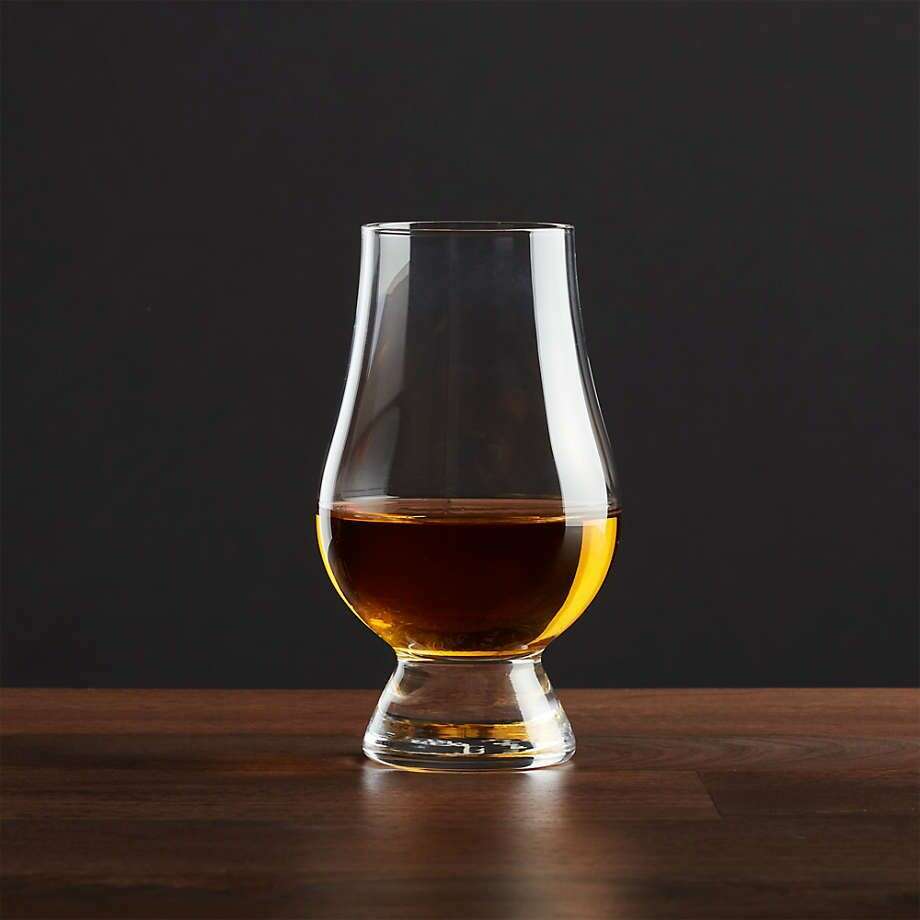
Use the same glass for every pour. Shape genuinely changes what reaches your nose — we went through the differences in our guide to choosing a bourbon glass — so mixing shapes mid-tasting introduces exactly the confound you are trying to remove. A matched set of tulips is ideal; a Amerit Glencairn Glass ($24.99) set is the standard answer, and eight identical wine glasses will do at a pinch.
Pour about half an ounce each. Keep water and plain crackers on the table, spit or dump if you want to make it through all eight with a functioning palate, and rest thirty seconds between pairs. Total time: about ninety minutes for four pairs done properly.
The scoring sheet
Score each glass on four axes, 1–5 each, before you compare anything: nose, arrival (the first two seconds), mid-palate, and finish length. Then add a fifth number that matters more than the other four combined: would you pour this again tomorrow?, scored 1–5. Plenty of bourbons win on complexity and lose on that question, and the answer to that question is the one that should decide what you actually buy.
Critically: write the scores down before the reveal, and do not let anyone announce a favourite until every sheet is finished. Preference is contagious. One confident person saying "four is obviously the best one" will drag a whole table, and you will have spent an evening measuring the loudest voice in the room.
What to do with the answer
Once the bags come off, three results are worth acting on. If you could not distinguish a pair at all, stop paying the difference — permanently, and without guilt. If you preferred the cheaper bottle, that is now your house pour and your bourbon budget just went further. And if a variable won consistently — the higher proof, the wheat, the extra age — use it as a filter on every shelf from now on. That is the actual deliverable here: not a favourite bottle, but a rule.
Run it once a season with a different variable each time and you will end up with a shelf assembled from evidence instead of from marketing. It is a cheaper hobby that way, and a considerably more interesting one.
Build your bracket
All eight bottles above are in stock now. Browse the full Bourbon collection to assemble your own pairs, widen the field with Whiskey if you want to test American against Scotch and Irish, or start from the Best Sellers if you would rather find out whether the crowd is right. New bottles land in New Arrivals every week — and if you are looking for a reason to run one this month, our Bourbon Heritage Month 30-day plan has a slot for it.

