


How to Host a Whisky Tasting Flight at Home for World Whisky Day 2026: A 4-Bottle, 6-Person Flight Blueprint (Scotch, Bourbon, Irish, Japanese)

World Whisky Day lands Saturday, May 16, 2026 — two days from now. If you read our Whisky 101 newcomer's guide earlier this week, you already have the four-style starter shelf in hand. The natural next move on Saturday night: pour all four side-by-side as a structured tasting flight with three to six friends. A flight is the single best way to learn what makes Scotch taste like Scotch and Bourbon taste like Bourbon — your tongue does the educating, not a textbook.
This guide is the exact blueprint a bartender or whisky-bar host would use: pour order, palate cleansers, glassware, water-and-pipette technique, scoring sheet, and what to tell your guests to look for at each station. It pairs cleanly with Tuesday's $200 starter shelf and is the structured Saturday-night activity for World Whisky Day 2026.
The 4-bottle flight: one from each style, ~$200 total
You want one representative bottle from each of the four major whisky-making regions. Smaller bottles work too — but the four below are the canonical "type specimens" for each style. Every bottle here is verified in-stock at Bourbon Central as of this morning.
- Scotch — Glenfiddich 12 Year ($69.09). The world's bestselling single malt, the textbook Speyside profile (pear, apple, honey, light oak). It's the bottle that defines what "single malt Scotch" means to most drinkers.
- Bourbon — Wild Turkey 101 ($32.99). 101 proof, high-rye mash bill, no chill filtration. The canonical Kentucky bourbon profile: caramel, vanilla, baking spice, charred oak, with a long warm finish that announces itself.
- Irish — Jameson Irish Whiskey ($38.09). Triple-distilled, blended Irish — smooth, easy, with light fruit and a clean malted finish. Jameson is the type specimen because it's the Irish style most drinkers have already tasted.
- Japanese — Nikka From the Barrel ($79.09). A blended Japanese whisky bottled at 51.4% ABV. Rich, layered, with the precision and balance Japanese whisky is famous for — the most accessible Japanese pour that still shows the style clearly.
Flight subtotal: $220.16. If you want to trim, swap Glenfiddich 12 for Monkey Shoulder ($43.09) — a blended malt Scotch that's just as Scotch-like at the entry level but $26 less. That brings the flight to $194.16.
Pour order: the rule is light-to-heavy
Palate fatigue is real. Start with the lightest and most delicate spirit, finish with the strongest and most assertive. The right order for this 4-bottle flight is:
- Glass 1: Irish (Jameson). Lightest, smoothest, lowest perceived intensity. Triple distillation strips the heaviest congeners, so your palate stays clean for what's next.
- Glass 2: Scotch (Glenfiddich 12). Light Speyside character — fruit and honey forward. Brings in oak influence but not heavy peat or smoke.
- Glass 3: Japanese (Nikka From the Barrel). Higher ABV than the first two (51.4% vs 40%), but the flavor is layered rather than aggressive. Sits in the middle for intensity.
- Glass 4: Bourbon (Wild Turkey 101). 101 proof and high rye — the most assertive pour of the four. Goes last because everything after it will taste muted.
This is intentionally not a regional-difficulty order; it's a palate-fatigue order. If you were running a flight that included a peated Islay like Laphroaig 10 Year ($59.99), the Islay always goes last — heavy smoke obliterates everything after it. For a 5-bottle flight, the order becomes Irish → Speyside Scotch → Japanese → Bourbon → Islay Scotch.
Pour size: 1/2 ounce per glass, per guest
Six guests × four pours × 0.5 oz = 12 oz total, or roughly half a 750mL bottle of each. You'll have plenty left over for a second tasting next weekend. Use a graduated jigger or a measured pour-spout — eyeballing leads to one bottle running dry and another half-full.
Want larger pours? For four guests, go 0.75 oz per glass; for two guests, 1 oz works and lets each person do two passes through the lineup (first nosing-only, then sipping). For a primer on tasting technique itself, our nosing-and-sipping guide walks through the mechanics; the technique transfers cleanly across all four styles.
Glassware: Glencairn is the standard, but tulip wine glasses work fine
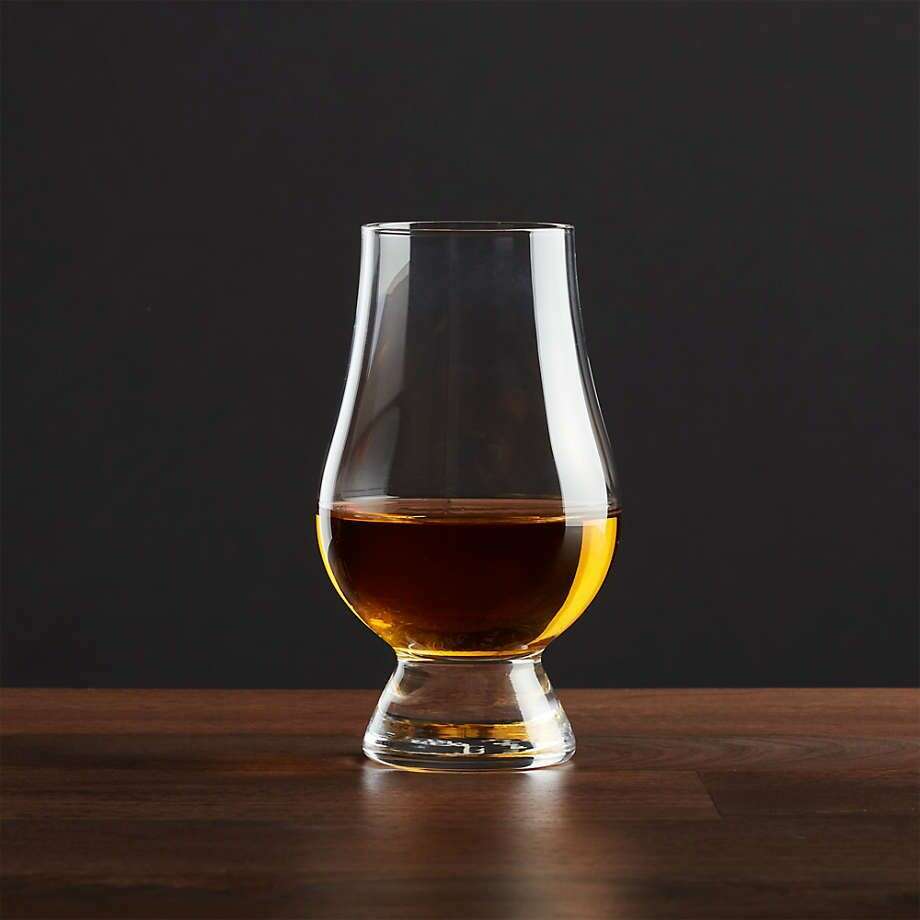
The Glencairn — a stubby tulip-shaped malt glass — is the global standard for whisky tasting. It concentrates aromatics at the rim and gives you the right amount of swirl. Four sets of four Glencairns is the dream setup; if you don't have 24 of them, a small white-wine glass (Riedel-style) substitutes well, and even a rocks glass works if you cup your hand over the top to capture the nose. Avoid: highball glasses (too tall, aromatics escape), and martini glasses (too open, alcohol overpowers nose).
One additional rule: do not use ice at a tasting flight. Ice mutes aromatics and chills the volatile compounds you're trying to evaluate. Room-temperature pours only — even for the bourbon. The Old Fashioned and the highball both have their place, but the tasting flight is for unadorned spirit.
Water and pipettes: the most-skipped technique
A few drops of room-temperature spring water (literally three to five drops, delivered via a pipette or a chopstick) opens up high-proof whisky. The water disrupts the alcohol-water surface tension and lets ester compounds volatilize — you'll smell fruit, oak, and vanilla that were hidden in the un-watered pour. This is essential for the Wild Turkey 101 station (101 proof) and the Nikka From the Barrel station (51.4% ABV). Less essential for the 40% Glenfiddich and Jameson, but worth trying as a comparison.
Set out a small pitcher of bottled spring water and a single eyedropper or pipette per station. Tell your guests: taste neat first, then add three drops of water, then taste again. The "what changed?" question is the most-rewarding question of the night.
Palate cleansers: water crackers and still water
Between glasses, two beats of palate-reset: a sip of room-temperature still water, and a small bite of an unsalted water cracker or plain bread. Avoid: cheese (fat coats the tongue and dulls subsequent pours), citrus (acid skews the palate), and chocolate (overwhelms everything). Slightly stale unsalted crackers are perfect — they absorb residual oils without adding their own flavor.
A whisky flight at a Scottish distillery uses oatcakes for this — if you can find them, they're the canonical pairing. Otherwise, water crackers work.
The scoring sheet: what to write down for each station
Even if your friends groan, hand each guest a small piece of paper or notecard at the start with four columns and three rows:
- Nose — what does it smell like before sipping? (Three words.)
- Palate — what does it taste like in the mouth? (Three words.)
- Finish — what flavor lingers after swallowing, and for how long? (Long / medium / short, plus one word.)
At the end, go around the table and read out the nose words for each whisky. The pattern that emerges — everyone independently writing "honey" for the Glenfiddich, "vanilla" for the bourbon, "smooth" for the Jameson, "rich" for the Nikka — is the moment a tasting flight clicks for people. They realize their palate is more discerning than they thought. Nothing converts a casual drinker into a whisky enthusiast faster.
Optional add-ons: build the flight bigger
If $200 is fine and you want to make this a 6- or 8-bottle blowout, the natural expansions:
- Add a peated Islay to position #5. Laphroaig 10 Year ($59.99) or the Highland Park 12 Year ($67.99) for a lighter-smoke alternative. This is the single biggest "wow" addition for guests who've never tried peated whisky.
- Add a sherry-cask Scotch to position #2.5. A Macallan or sherry-finished Glendronach adds the dried-fruit / Christmas-cake profile that's a third axis of Scotch flavor beyond Speyside-fruit and Islay-peat.
- Add a Single Pot Still Irish to position #1.5. Redbreast 12 Year ($88.09) shows the spicier, oilier side of Irish whisky that Jameson alone doesn't reveal. If you're running both, taste them back-to-back and the contrast tells the whole Irish story.
- Add a high-end Japanese to position #4.5. Yamazaki 12 Year ($179.99) or the Hakushu 12 Year ($199.99) — single malt Japanese, distinct from the Nikka blend, and the upgrade most guests will remember the longest.
- Add an aged bourbon to position #6. Knob Creek 9 Year ($49.99) shows what age does to bourbon vs the younger Wild Turkey 101. For a much higher tier, Elijah Craig Small Batch ($40.99) or Four Roses Small Batch ($37.99) round out the bourbon picture.
The maximum reasonable flight for a single evening is 6 pours. Beyond that, palate fatigue dominates and guests stop being able to distinguish between glasses. Save the seventh and eighth bottles for a follow-up tasting the next week.
Hosting flow: the 90-minute schedule
A well-run home flight runs about 90 minutes from first pour to last cracker. Here's the schedule:
- 0:00–0:10. Welcome, hand out scoring sheets, brief explanation of the order and the technique. No drinking yet.
- 0:10–0:25. Pour Station 1 (Jameson). Three minutes of nosing, two minutes of sipping, five minutes of comparing notes around the table.
- 0:25–0:40. Station 2 (Glenfiddich 12). Same rhythm.
- 0:40–0:55. Station 3 (Nikka From the Barrel). Add water comparison at this station for the first time.
- 0:55–1:15. Station 4 (Wild Turkey 101). Longest station — water comparison and discussion of the bourbon flavor.
- 1:15–1:30. Open conversation. Compare scoring sheets. Vote on favorite. Pour a re-taste of the consensus favorite if there's bottle left.
For follow-up content after the flight, our World Whisky Day cocktail guide covers eight cocktails (one for each style, plus crossover builds), the Penicillin recipe spotlight shows the Monkey Shoulder + Islay float build that's the canonical "post-flight" cocktail, and the Japanese highball guide explains the technique for cocktailing the Nikka if you have any left.
What to drink with the flight (if anything)
The honest answer: nothing. A tasting flight is a tasting flight. But if you're running it as the centerpiece of a dinner party, the food best served alongside whisky tasting is what the Scots call charcuterie-but-make-it-light: a small board of unsalted nuts, dried apricots and figs, dark chocolate squares (after the flight, not during), and maybe a wedge of mild aged cheese. Stay away from anything spicy, garlicky, or strongly flavored — the food's job is to fill space between pours, not compete with them.
For longer Memorial Day–weekend planning a week from now, our Memorial Day BBQ + bourbon pairing guide takes a different approach — bigger pours, food-forward, designed for a backyard rather than a tasting room.
The bigger picture: why structured tastings matter
Most people drink the same one or two bottles of whisky for years because nobody ever taught them what to look for in the others. A 4-bottle flight on World Whisky Day 2026, with the right pour order and a piece of paper to score on, does the teaching in 90 minutes. Your guests will leave with a clear preference (almost always one of the four styles speaks loudest), and they'll know why — which is the actual definition of taste.
For deeper exploration after the flight: /collections/scotch, /collections/bourbon, /collections/whiskey (which carries the Irish lineup), and /collections/japanese-whiskey. Our broader best-sellers collection shows what's moving fastest right now — a useful index of what other whisky drinkers are landing on after their own tastings.
The 8-item shopping list (everything you need)
- Glenfiddich 12 Year ($69.09)
- Wild Turkey 101 ($32.99)
- Jameson Irish Whiskey ($38.09)
- Nikka From the Barrel ($79.09)
- Glencairn glasses (or small white-wine glasses) — 4 per guest
- Pipette or eyedropper, plus a small pitcher of room-temperature spring water
- Unsalted water crackers
- Notecards or a printed scoring sheet
For shoppers ordering today (Thursday May 14) for Saturday-night delivery, every bottle on the list above is in stock. Shop the full Saturday-night-ready shelf at /collections/whiskey, or jump straight to /collections/scotch, /collections/bourbon, and /collections/japanese-whiskey. Happy World Whisky Day.

