


How to Taste Bourbon Like a Pro: A Beginner's Guide to Nosing, Sipping & Scoring (2026)
Tasting bourbon isn't about knowing fancy words for caramel — it's a repeatable five-step routine that takes ten minutes and lets you actually compare two bottles side by side instead of just declaring one "smooth." Below is the exact tasting method we use at our in-store events, plus the four-bottle starter flight we recommend if you've never done a real tasting before.
Why most people taste bourbon wrong
The single biggest mistake new bourbon drinkers make is treating tasting like drinking. They pour two ounces over a fistful of small ice cubes, take a long pull, and try to form an opinion in the four seconds before the second sip. By the time they're done, the alcohol has anesthetized their tongue, the temperature has muted half the aromatics, and the spirit has been diluted past the point where character shows up.
A real tasting reverses every one of those mistakes. Small pour, neutral glass, no ice (yet), nose first, sip slow, write it down. Once you do this with two or three bottles back-to-back, you'll start to actually taste the difference between, say, a wheated bourbon and a high-rye one — and you'll know what you're looking at on the shelf for the rest of your life. If you're still figuring out what those terms mean, our Bourbon vs. Rye guide covers the basics.
The 5-step bourbon tasting method
Step 1: The right glass and pour size
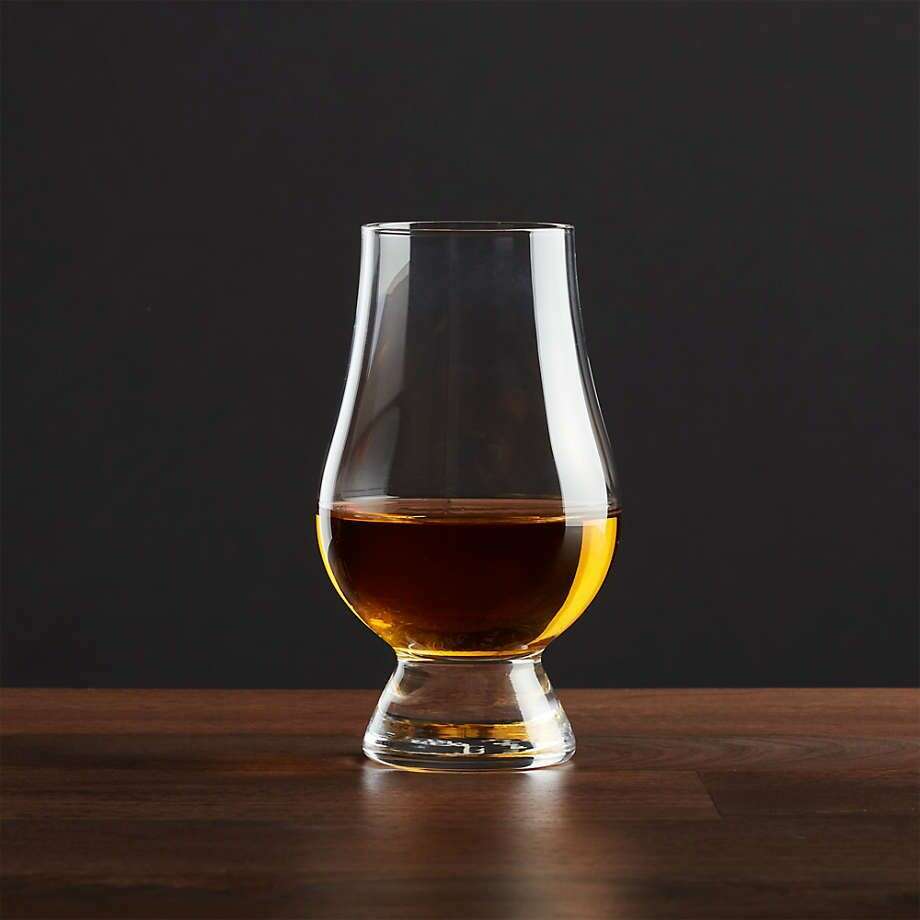
Use a Glencairn glass. The tulip shape concentrates aromatics at the rim, where your nose meets them — a rocks glass scatters them in every direction and an old-fashioned glass is wider than your nose. If you don't have a Glencairn, a small wine glass (white wine size, not red) is a fine substitute. A snifter is too big.
Pour about three-quarters of an ounce. That's not a typo. A small pour means you taste the entire glass before the spirit warms past optimal temperature, and it lets you do four bottles without driving home. The American "two-ounce pour" was invented by bartenders, not tasters.
Step 2: Look
Hold the glass against a white surface (a piece of paper, a napkin) and look at the color in natural light. Bourbon ranges from pale straw to deep mahogany, and color tells you something about age and barrel char. A young bourbon like Evan Williams 1783 Small Batch ($38.09) will be lighter than an aged single-barrel like Eagle Rare 10 Year ($49.99). You're not looking for a "right" answer — you're building a baseline.
Tilt the glass so the bourbon coats the side, then watch the "legs" run back down. Slow, fat legs usually mean higher proof or a wheated mash bill (more body); fast, thin legs mean lower proof or a higher-rye mash bill.
Step 3: Nose
This is the step everyone skips and the step that matters most. Hold the glass about an inch below your nose with your mouth slightly open, and inhale gently — not a deep sniff, more like passing a stranger on the street. Your nose can pick up thousands of aromatic compounds; your tongue can pick up five flavors. Do the work upstairs.
What you're looking for: caramel, vanilla, oak, dried fruit, baking spice, leather, fresh-baked bread, corn, mint, peppermint, banana, citrus peel. Don't try to identify all of them at once. Pick the loudest two and write them down. With Buffalo Trace ($78.99), most people get vanilla and brown sugar first; with Four Roses Single Barrel ($54.99), it's usually rye spice and ripe pear.
Step 4: Sip
Take a very small sip — less than you think. Hold it on the tip of your tongue for a second, then move it around your mouth before swallowing. The first sip will burn no matter what; this is called the "Kentucky Chew," and it's how bourbon distillers themselves do it. The burn is your tongue's nerve endings reacting to ethanol, not the flavor of the spirit. Take a second sip 30 seconds later and the burn drops by half. Take a third and you'll start tasting actual bourbon.
Look for three things on the palate: the front (what you taste in the first second), the middle (what develops as you hold it), and the finish (what's left after you swallow). A good bourbon has all three; a flat one collapses immediately. Blanton's Original Single Barrel ($119.99) is the textbook example of a long, well-shaped finish — honey and orange peel that linger for 30 seconds.
Step 5: Score (and add water)
Write down a one-line note: nose, palate, finish, and a 1–10 score. Don't overthink the score — your gut is right. Then add a few drops of water (literally three or four drops, not a pour) and re-taste. Water lowers the proof, opens up esters, and changes the profile measurably. Some bottles get better with water; cask-strength bourbons almost always do. For more on why high-proof bourbons benefit from water, our Barrel Proof Bourbon 101 guide covers the chemistry.
The 4-bottle starter flight
If you've never run a tasting before, here's the lineup we'd build. Four bottles, four mash bill styles, all available for under $250 total — enough to host a small group and walk away with real opinions.
1. The wheated bourbon: Maker's Mark
Maker's Mark Bourbon ($37.09) replaces rye in the mash bill with red winter wheat, which makes the spirit softer, sweeter, and less spicy. Most people pick it up first because it's the easiest entry point in the lineup — caramel, butter, light vanilla. If you want a deeper wheated example, taste W.L. Weller Special Reserve ($59.99) right after; same wheated style, more years in the barrel, dramatically different finish.
2. The high-rye bourbon: Four Roses Small Batch
Four Roses Small Batch ($37.99) is the opposite of Maker's — its mash bill is heavier on rye, which means more pepper, mint, and orange peel up top. Pour Maker's and Four Roses side by side and the difference is so obvious that even a first-time taster nails it. This is the moment most people start to "get" what mash bill actually does.
3. The traditional bourbon: Buffalo Trace
Buffalo Trace ($78.99) is the textbook middle-of-the-road bourbon — neither high-rye nor wheated — and it sits at the center of the flight as a benchmark. Brown sugar, vanilla, a touch of mint, smooth finish. Almost every bourbon drinker has had it; few have tasted it next to its siblings on the same table.
4. The single barrel: Blanton's or Eagle Rare
End with something that shows what extra age and single-barrel selection do. Eagle Rare 10 Year ($49.99) is the value play — ten years of barrel aging at a price most allocated bourbons can't touch. Blanton's Original Single Barrel ($119.99) is the splurge — bottled one barrel at a time, with batch-to-batch variation that makes every release a little different. If you only have room for one of these, pick by budget; either teaches the same lesson.
Three more bottles worth tasting
If you want to extend the lineup beyond four, three bottles cover the rest of the major American whiskey territory. Larceny Small Batch ($40.09) is a wheated bourbon at a budget price that pours close to Maker's. Angel's Envy ($54.99) is finished in port wine barrels — a textbook example of how a finishing cask changes the profile. And Colonel E.H. Taylor Small Batch ($94.99) is bottled-in-bond at exactly 100 proof, demonstrating what a legally regulated category looks like in the glass. For more on what those classifications actually mean, see our Single Barrel vs. Small Batch guide.
Common tasting mistakes
Beyond the ones already covered, three more habits will sabotage you. Tasting cold. Bourbon should be at room temperature, not chilled. The freezer trick mutes everything except sweetness. Tasting tired. If you've already had a glass of wine with dinner, your palate is shot — taste before you drink, not after. Tasting in scented spaces. Candles, cologne, and even a kitchen mid-cooking will dominate the nose. Move to a neutral room.
And one more: don't peek at the bottle. The strongest predictor of how someone scores a bourbon is the price tag they saw two minutes earlier. If you really want to know what you like, taste blind — pour from labeled bags or have someone else hand you the glasses without telling you which is which. The results almost always surprise people.
Where to start your tasting collection
Every bottle in this guide is in stock at Bourbon Central's bourbon collection. For broader whiskey options, browse the whiskey collection or check the best-sellers list for what's moving fastest. New to the category overall? Our Best Bourbons Under $50 Buying Guide is the right place to start the shopping list, and the new arrivals page shows what just landed.
Final pour
The five-step method — look, nose, sip, finish, score — takes ten minutes per bottle once you're used to it. Run it twice and you'll start picking out vanilla, caramel, and rye spice with confidence; run it on a four-bottle flight and you'll know within an hour what mash bill style you actually prefer. That's the whole point: not to sound smart, but to taste with your own tongue and remember what you found. The next time someone hands you a bottle and says "try this," you'll have the language to answer.
Build your starter flight: Maker's Mark · Four Roses Small Batch · Buffalo Trace · Eagle Rare 10 Year · or shop the full bourbon collection.

